Short answer
Hazmat spill response is applied chemistry. Responders identify the substance, then use its properties, such as vapor pressure, vapor density, flammability, reactivity, and solubility, to decide how far to isolate the area, which protective gear to wear, how to contain the spread, and whether to absorb, neutralize, or recover the material. The science determines both the order of work and what is safe to attempt.
Identification comes before anything else
Two clear liquids spilled on a warehouse floor can call for opposite responses. One might be water-based and harmless. Another might give off vapors that ignite from a light switch, or react violently with water from a hose. Until responders know what they are facing, every action is a guess.
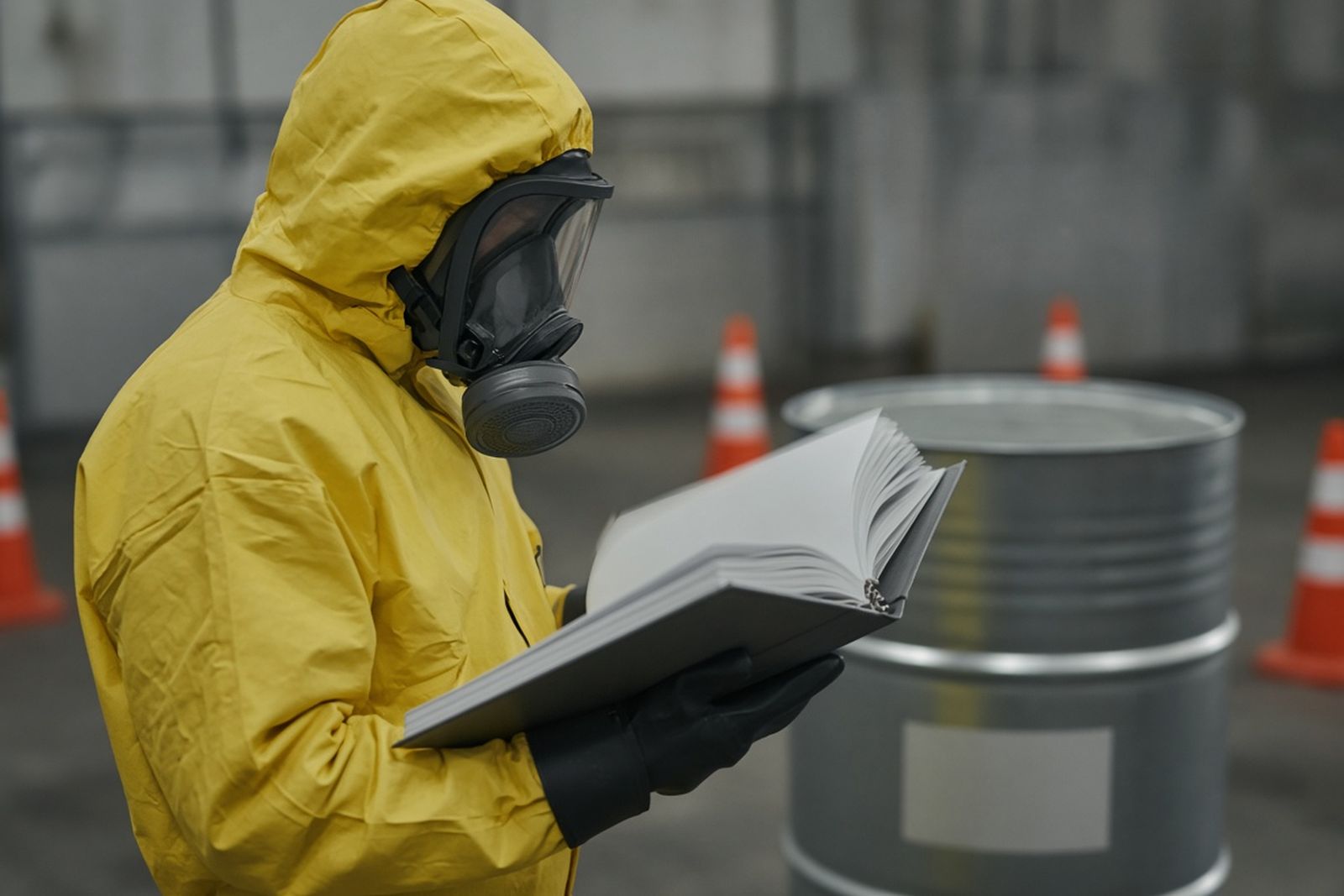
Identification starts with labels, placards, shipping papers, and safety data sheets. A safety data sheet lists physical properties, health hazards, fire-fighting measures, and accidental release procedures. Responders also rely on reference guides that map placard numbers to initial isolation distances and protective actions.
When labels are missing or damaged, responders may use air monitors, pH paper, or field test kits to narrow the possibilities. The unknown is always treated as hazardous until proven otherwise.
Undeclared shipments are a known problem in transport. Lion Technology, analyzing PHMSA data in 2023, reported about 1,500 transportation incidents involving undeclared hazardous materials each year, totaling 11,430 over the decade to 2023. That is one reason responders do not trust the absence of a label.
How far back people need to stand
Isolation zones are drawn from the chemistry. Responders commonly set a hot zone where the hazard exists, a warm zone where decontamination happens, and a cold zone where command, staging, and support stay clean. The size of each depends on the substance, the quantity released, the weather, and the terrain.
For an unknown release, the first distances are deliberately generous. It is far easier to let people back in once monitoring shows safe readings than to recover from placing a command post inside a vapor cloud.
Shelter-in-place is sometimes the better choice than evacuation. If a gas plume will pass quickly, keeping people indoors with windows shut and ventilation off may expose them less than sending them outside to walk through it. Public officials make that call, and you should follow their instructions over any guess of your own.
How vapors decide how far the danger reaches
A spilled liquid does not stay a liquid for long if it evaporates readily. Vapor pressure describes how quickly a substance turns to gas at a given temperature. High vapor pressure means a spill can create a breathing hazard or a flammable cloud within minutes.
Vapor density matters just as much. Vapors heavier than air sink and flow along the floor, pooling in basements, pits, drains, and low-lying areas, sometimes far from the original spill. Lighter vapors rise and disperse, though they can still collect under ceilings.
Temperature and wind change the picture constantly. A spill in summer heat produces more vapor than the same spill on a cold morning. Wind can carry vapor toward a neighborhood or away from it, which is why responders stage upwind and uphill whenever they can.
Odor is not a reliable guide. Some chemicals smell strong at harmless levels, while others are dangerous before anyone notices a smell. Responders rely on instruments rather than noses.
What chemical properties shape the protective gear?
Personal protective equipment is chosen to match specific hazards. A corrosive liquid calls for splash-resistant suits and gloves rated for that chemical. A toxic gas may require supplied air. A flammable atmosphere may limit which tools and equipment can enter the area.
Glove and suit materials are not universal. A material that resists acids may break down quickly in contact with certain solvents. Manufacturers publish permeation and breakthrough data, and trained responders check it rather than assuming one suit covers everything.
Levels of protection range from full encapsulation with self-contained breathing apparatus to lighter splash protection with air-purifying respirators. The decision rests on what the monitors read, what the substance is, and what tasks the entry team must perform.
- Flammability: controls ignition sources, tool choice, and metering for explosive limits
- Toxicity: sets respiratory protection and exposure time limits
- Corrosivity: determines suit and glove material and eye protection
- Reactivity: decides what must be kept away, including water and other chemicals
- Vapor density: guides where to monitor and where vapors may travel
Why does containment come before cleanup?
A spill that keeps spreading keeps growing the problem. Liquids follow gravity into drains, soil, and waterways, and every foot they travel adds contaminated surface to clean. Stopping the spread first shrinks the job.
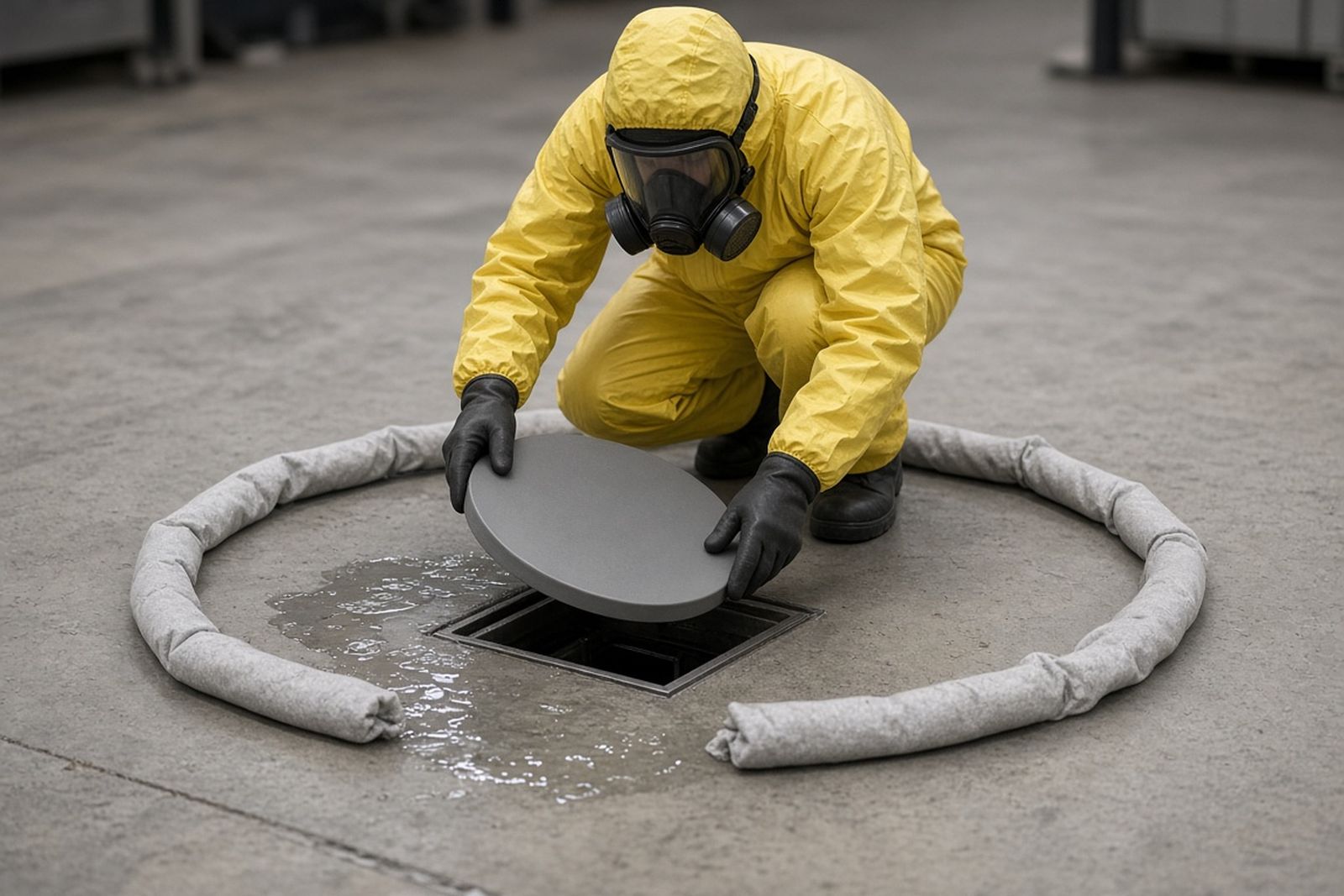
Containment tools reflect the physics of flow. Berms and booms create barriers. Drain covers and plugs protect storm and sanitary sewers. Absorbent socks surround a pool so it cannot creep outward. Diking downhill from a leak catches material before it reaches a ditch or stream.
Stopping the source is part of containment too. Responders may upright a drum, plug a puncture, close a valve, or transfer contents from a damaged container to a sound one, but only when the chemistry and conditions make that safe.
Soil and pavement behave differently. Asphalt and concrete look solid, but their pores and cracks absorb liquids, and some solvents soften asphalt. Where material reaches bare soil, responders may need to excavate the stained area rather than simply absorb what sits on top.
Absorb, neutralize, or recover
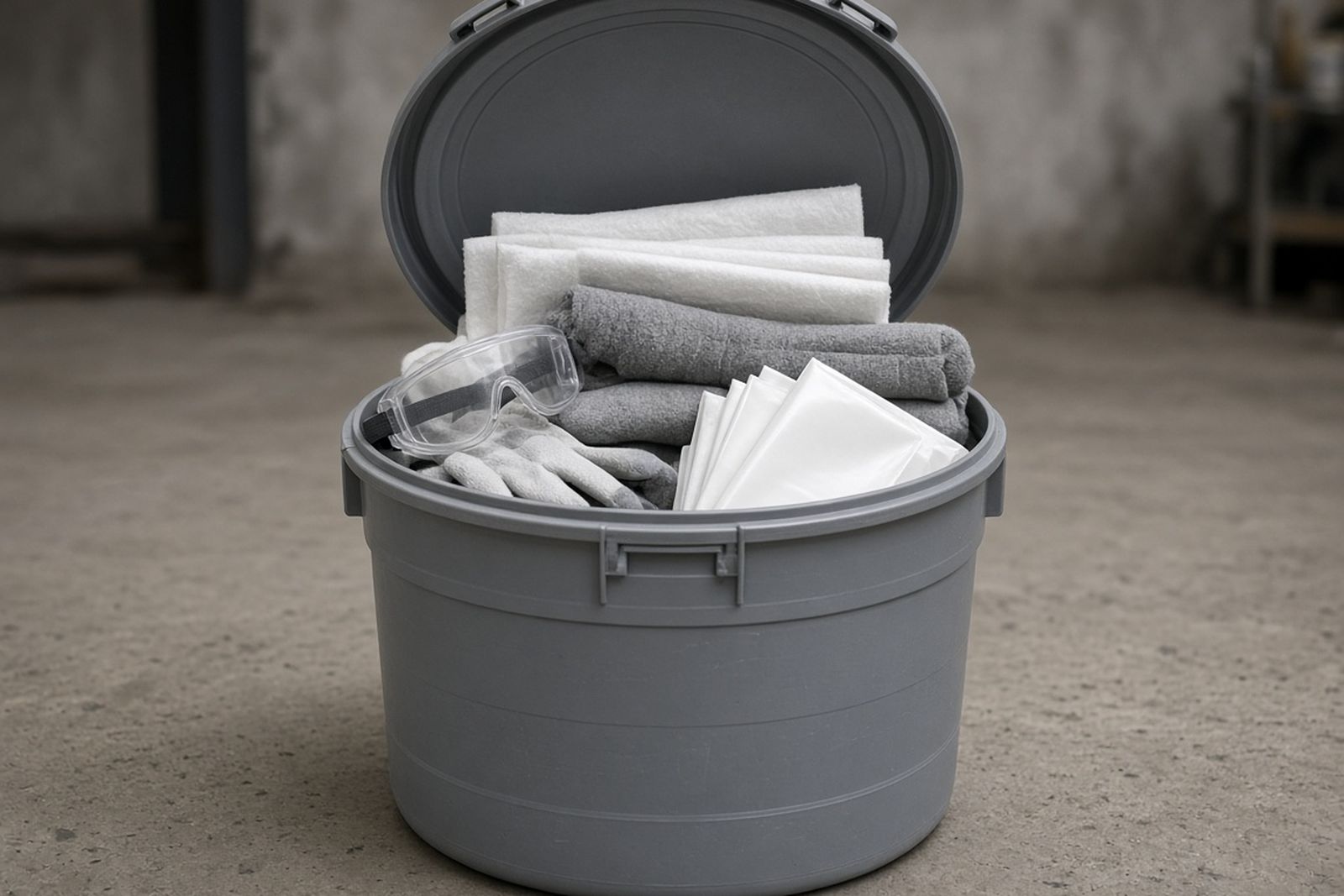
Absorption is the most common approach for small and moderate spills. Absorbent pads, granules, and pillows pull liquid in so it can be scooped, packaged, and removed. The absorbent must be compatible, because some materials react with certain chemicals or generate heat.
Neutralization changes a hazardous chemical into a less hazardous one. A mild base can neutralize an acid, and a mild acid can neutralize a base. The reaction often produces heat and gas, so neutralizers are applied slowly and carefully, starting from the edges.
Recovery uses pumps or vacuums to collect free liquid, often into drums or tanks. It is common for large volumes, for materials that have value, or when absorbing would create too much contaminated waste.
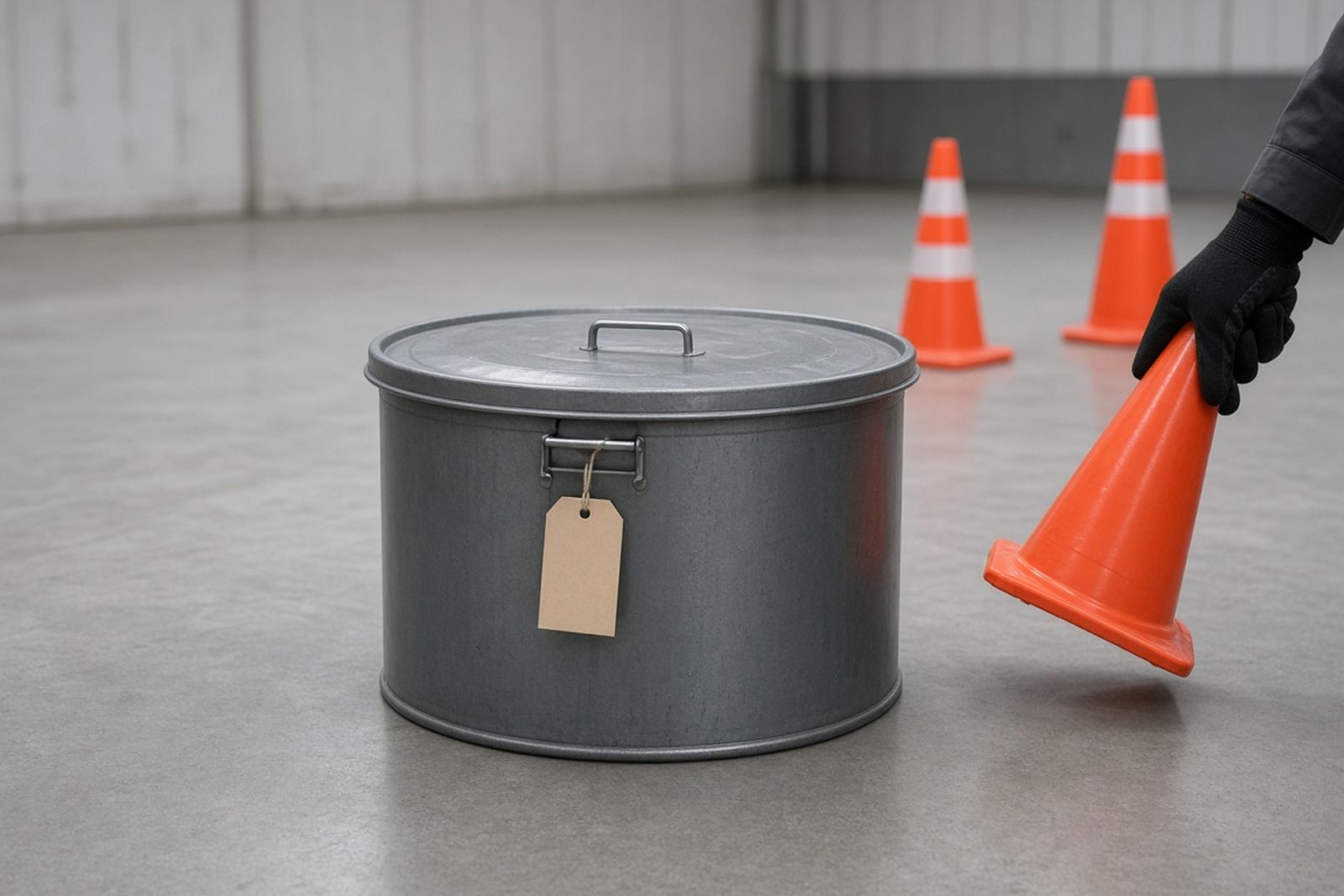
In each case, the recovered material becomes waste that must be characterized, packaged, labeled, and shipped to a permitted facility. Response does not end when the floor looks clean.
Why do reactions between chemicals raise the stakes?
Many dangerous spills involve more than one substance. A shelf collapse in a storeroom might mix an oxidizer with a fuel, or an acid with a cyanide salt. Some combinations produce toxic gas, some produce fire, and some produce both.
Water is a common trap. It is the instinctive tool for washing a spill away, but certain metals, powders, and reactive chemicals burn or release gas when wet. Washing a spill into a drain can also carry it into a system that was never designed to handle it.
Responders separate incompatible materials, keep water away from water-reactive substances, and plan containment so that runoff does not meet other chemicals downstream. This is one of the main reasons untrained people are asked to leave the area rather than help.
Putting the properties together
Each property on its own points to a precaution. Together, they set the order of work. The sequence below is what the chemistry demands whenever a corrosive or reactive liquid is spreading toward other products and a drain, which is one of the most common indoor scenes.
People leave first, because vapors and reactions cannot be predicted until the substance is known. Responders then read labels and safety data sheets, check which nearby products are incompatible, and meter the air at the doorway before anyone enters.
The entry team, in suits and respiratory protection chosen for the material, covers the drain before anything else, then places absorbent barriers between the spill and any incompatible products. Those products are moved only once the path is clear. The liquid is contained with a compatible absorbent and, where appropriate, neutralized slowly from the edges inward while monitors watch for gas.
Waste is drummed, labeled, and staged for a hazardous waste transporter, and the floor is tested, for example for pH, before the area reopens. At no point does anyone hose the spill toward the drain.
How do responders know when a site is clean?
Clean is defined by measurement, not appearance. Depending on the chemical, responders may use pH testing on surfaces, air monitoring for vapors, wipe samples sent to a laboratory, or soil sampling where material reached the ground.
Decontamination of people and equipment follows the same logic. Responders leaving the hot zone pass through a staged line where suits, boots, and tools are rinsed or wiped with a solution suited to the chemical, and the rinse water is collected as waste rather than allowed to run off.
Exposure lingers in unexpected ways. After a 2014 mercaptan release in Eight Mile, Alabama, Behbod and colleagues reported that 97.9% of residents in the nearer zone recalled the odor versus 77.6% in the farther zone. Even odorous chemicals that are cleaned up quickly can reach people far from the source, which is why post-cleanup checks can extend beyond the spill footprint.
Regulators may set cleanup standards or require notifications depending on the substance and quantity, so keep copies of all test results and waste records.