Knowledge check with explanations

Hazmat Spill Response quiz and study guide

Find out what you already understand, then read the parts you missed.

This quiz checks whether you know the basics of responding to a spill at a workplace or property. The spill may be a chemical, fuel, oil, solvent, battery, or unknown substance. The quiz is for facility managers, fleet supervisors, property managers, and safety staff. They are not hazmat technicians, but they will make the first calls when something spills. The questions cover spotting hazards and knowing who is in charge. They cover protecting people and drains. They cover the difference between removing a product and cleaning the surface so it is safe. They also cover where spill waste goes and the records that agencies and insurers expect. A high score suggests you are ready to lead the first minutes and work well with a contractor.

Get an email reply about hazmat spill response

Send a short message and get an instant email confirmation. A coordinator then replies by email. This form does not send emergency help; call 911 first if anyone is in danger.

Tell us what you need help with. Share a short description; please leave out medical details, access codes, and other sensitive information.

A request does not confirm a booking. For immediate danger, contact local emergency services.

Or email info@hazmatspillcleanup.online

If this material is new to you, read the study guide first. Each section explains one key idea in plain words. It also points out where rules for your site, state, or county take over. The quiz is anonymous, and you can take it again. When you miss a question, follow the answer back to the idea instead of memorizing a letter. The goal is a clear picture in your head that you can use on a spill you have never seen. Nothing here counts as HAZWOPER training or any other required course. It is a self-check to help you see where your plan and training need work. Take your time with each answer.

Hazmat Spill Response knowledge check

15 questions about real hazmat spill response situations: staying safe, what happens, cost, choosing help and the rules. Every answer comes with a short explanation.

Why this quiz matters

Knowing these basics makes it easier to spot bad advice and ask a company the right questions. This quiz is educational — it does not certify anyone. After the quiz, review the explanations for questions you missed. For professional guidance on your specific situation, use the contact form at the top of the page for an email reply. Hazmat Spill Response is classified as extreme-risk — every question here relates to real hazards where professional remediation is essential.

Progress1 / 15
SafetyQ1

A drum with no label is leaking in the back lot, and no one knows what is in it. What should happen first?

Study guide: the six ideas behind the questions

Read these before or after the quiz. They cover the concepts every question draws on, written for hazmat spill response specifically.

1Recognizing the hazard before you act

Every spilled liquid has a mix of hazards. Spotting them starts with knowing what it is. Look for the container label, a warning sign, or shipping papers. Then pull the safety data sheet. The SDS tells you whether the product can burn, eat away skin or metal, poison you when breathed, react with water, or a mix of these. Your senses are not a safe guide. Some toxic vapors have no smell, and a strong smell does not mean the level is safe. Signs like fumes, bubbling, heat, color change, or a shiny film moving toward a drain make things more urgent. Treat anything you cannot name as hazardous until a qualified person says otherwise. Battery incidents add electric shock and heat risks that normal chemical thinking does not fully cover.

2Responsibility and who has authority at the scene

The site owner or operator is usually responsible for the spill. That includes reporting, cleanup, and cost. The exception is when a shipper or contractor caused it, which is often argued about later. Inside the building, your written emergency plan should name who orders people out, who calls outside help, and who may try to contain the spill. Once the fire department or a hazmat team arrives, they take charge. Your role then is to give them facts, such as the SDS, site maps, and drain locations. OSHA's HAZWOPER rule at 29 CFR 1910.120 covers the responders and any workers who do more than leave the area. Federal, state, and local environmental agencies set the reporting and cleanup rules. Those rules vary by state and county.

3Containment that protects people and the environment

Containment starts with distance. Move people upwind and uphill and close doors. Stop the flow at its source only if you can do it without breathing vapors or touching the liquid. Next, keep the spill from spreading toward drains, soil, and chemicals it could react with. Use drain covers, absorbent socks, or small barriers placed from the outer edge inward. Airflow is a judgment call. Fans can thin out toxic vapors, but they can also push vapors that burn toward a spark. So check the SDS and your plan. Absorbents must be safe to use with that chemical, since some react with acids or strong oxidizers. Containment only holds things in place until trained responders arrive. It does not replace cleanup. Staff should never risk their safety to make a puddle smaller.

4Cleaning versus decontamination after a chemical release

Removing the loose liquid and soaked absorbent is cleaning. The product you can see is gone. The next step removes the hidden part. Some residue soaks into concrete, cracks, floor joints, or other porous surfaces. That residue must be neutralized, drawn out, or removed so the surface is no longer harmful to touch or breathe near. The method depends on the chemical. A caustic may be neutralized under careful control. A fuel may need degreasing and vapor checks. A solvent that soaked into soil may need digging out. Testing tells the two steps apart. A floor that looks clean can still give off fumes or still burn skin. So the choice to reopen should rest on testing, wipe samples, or written standards from a qualified person, not looks. Bleach-based trauma cleanup methods have no place in chemical cleanup.

5The waste path for absorbents, liquids, and contaminated media

Everything used to hold and clean a spill becomes waste with the same hazards as the product. That includes soaked pads and socks, recovered liquid, dirty soil, used gear, and rinse water. This waste must be tested and sorted, usually under the federal hazardous waste law (RCRA), to see if it counts as hazardous waste. If so, it needs proper containers and labels, a start date, and a waste shipping record. It also needs a hauler approved for hazardous waste and a permitted site to treat, store, or dispose of it. Fuel-soaked pads in a dumpster or rinse water sent to a storm drain are common violations. Oil-only pads from a small fuel spill may follow a different path in some states, but the business that made the waste must confirm. Your contractor should explain the waste codes, where the waste goes, and how the signed shipping records come back to you.

6Documentation and verification that hold up later

A spill file has to satisfy several readers. These include your insurer, your environmental agency, your company safety program, and maybe a court. Start writing things down once the scene is safe. Note the time you found the spill, the product, about how much spilled, where it went, who was exposed, and what was done. Photograph the source, the spread, the drains, and the containment before cleanup begins. Save agency confirmation numbers, the contractor's scope, daily logs, test readings, waste records, and waste shipping records. Verification means a qualified person wrote down the standards for reopening the area. It also means they recorded proof that those standards were met. Keep the file as long as your state and your insurer require. Use it to update your plan and training.
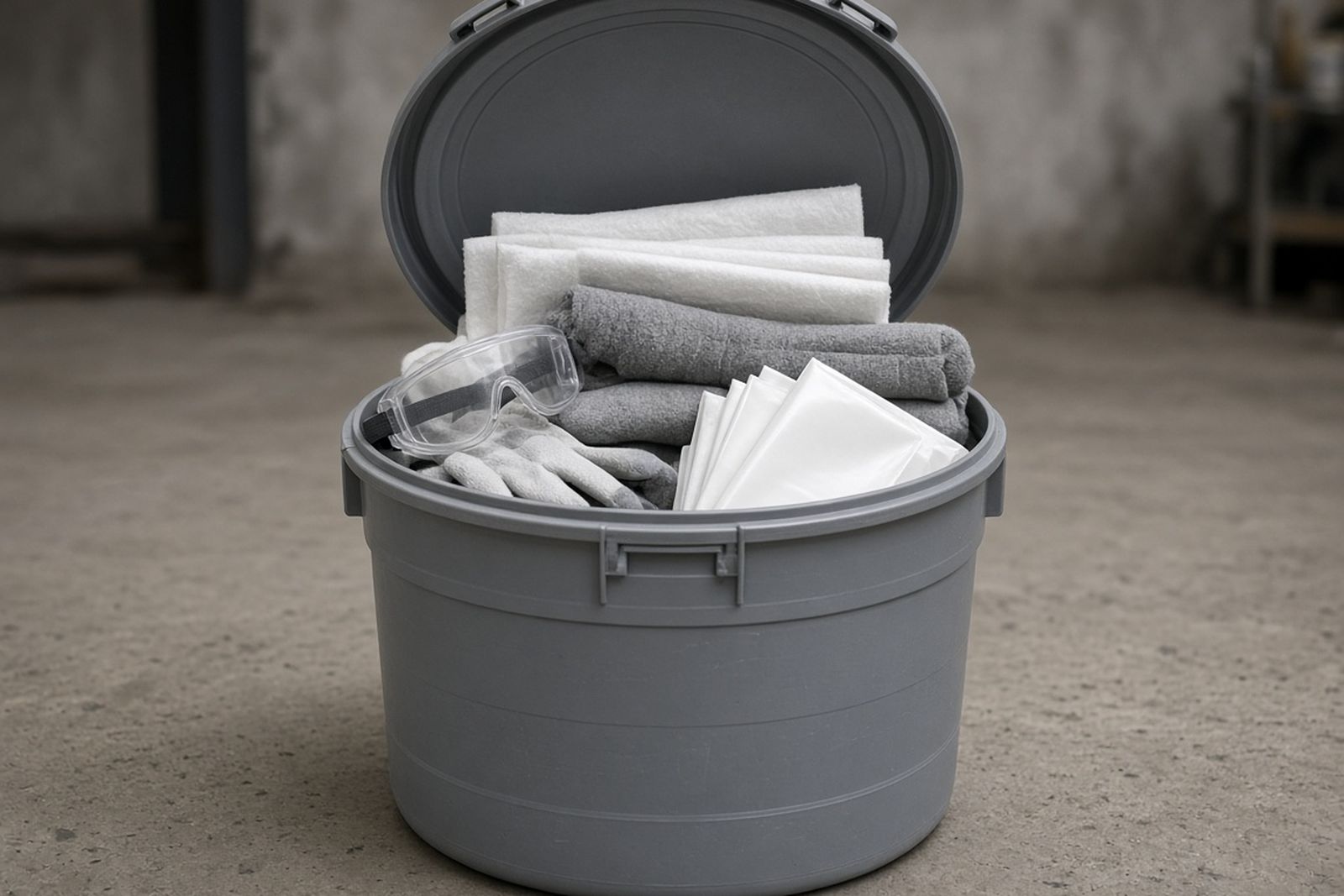
Open spill kit drum holding absorbent pads, goggles, gloves and disposal bags
Illustrative photo, not a job record. Open spill kit drum holding absorbent pads, goggles, gloves and disposal bags.

Hazmat Spill Response facts the quiz draws on

89%

89% in affected counties heard of the spill on the day it occurred.

Read with care: Self-reported behaviour; event-specific communications.

Source: Savoia et al. (2015)690 West Virginia adults surveyed online in February 2014, including affected and unaffected areas.

36.5%

36.5% overall sought medical care for odor-related symptoms.

Read with care: Reported symptoms and odor; not measured individual exposure doses.

Source: Behbod et al. (2014)204 household representatives surveyed in two distance zones, September 2012.

10,000 more filings

PHMSA received about 10,000 more hazmat incident filings in 2022 than in prior years after moving to electronic reporting.

Read with care: Reflects reporting changes as much as real incident growth.

Source: PHMSA statement (via Data Liberation Project) (2023)United States, PHMSA Form 5800.1 filings, 2022

1.2 million per day

More than 1.2 million hazmat shipments move every day in the United States, totaling over 3.3 billion tons valued above $1.9 trillion annually.

Read with care: Secondary source; the original DOT budget document was not fetched directly.

Source: DOT PHMSA (via Wikipedia, citing PHMSA FY2023 budget estimates) (2023)United States, all modes, PHMSA FY2023 congressional justification

These figures are public research and agency data, not this network's own job records. Keep each number with its population, year and limits; none of them predicts cost, timing or outcome at a specific property.

Questions about the hazmat spill response quiz

Does this quiz count as HAZWOPER awareness training?

No. HAZWOPER training under 29 CFR 1910.120 must come from a program that meets the rule's content and record-keeping needs. Awareness-level training is set by your employer's plan. This quiz is a knowledge check. It helps you see where formal training and plan updates are needed. Your employer decides which level of training applies to each job.

Why does the quiz include battery questions?

More fleets and sites now store lithium and lead-acid batteries. Incidents with them act differently from liquid chemical spills. A battery can overheat in a chain reaction, give an electric shock, or leak corrosive liquid. Each of these needs its own response. The quiz tests whether you know that a normal absorbent kit does not handle a damaged battery. Using water on a lithium fire is a separate question for your fire plan.

Are reporting questions based on specific numeric thresholds?

No. The quiz does not quote amounts. Reporting limits vary by substance and by federal, state, and local rule, and they change over time. Correct answers stress naming the product, checking the SDS and your plan, and calling the right agency when unsure. They do not ask you to memorize values. Your written plan should hold the current figures.

What if my state's requirement differs from the quiz answer?

Your state or county rule is the one that applies at your site. The quiz teaches general federal ideas and widely used practice. It always tells you to check locally. If you see a difference, take it as a cue to confirm the exact rule with your state environmental or job safety agency. Local rules can be stricter than federal ones.

Can I use the study guide for a tabletop exercise?

Yes, as background reading and as a source of talking points. Use it along with your site's emergency plan and your SDS library. Add a map of storm drains and shutoff valves and your contractor's contact details. That way the drill ends with your real procedure, not just general ideas. Finish by giving out follow-up tasks with owners and dates.

Does the quiz cover unknown substances?

Two questions deal with an unlabeled drum and a puddle from an unknown source. The expected approach is careful. Close off the area and keep people out. Never try to identify it by smell or taste. Do not add water or neutralizers. Bring in qualified responders who can safely test the material before cleanup. Patience at this stage prevents most injuries.

How does the quiz treat storm drains and soil?

As top-priority paths for a spill to travel. Questions test whether you know that a storm drain usually leads straight to open water. They also test whether you know that soil contact can mean digging, not just surface cleaning. Both often change what must be reported and how big the cleanup is. Protecting those paths early is a theme throughout. Map both before you need them.

What other visitors think

Poll results

Every count is a real visitor vote; nothing is seeded or padded. One vote per poll per device, and you can change your answer.

Safety

How prepared is your site for a chemical or fuel spill right now?

No visitor votes yet
Your experience

In your most recent spill, what was the first action taken?

No visitor votes yet